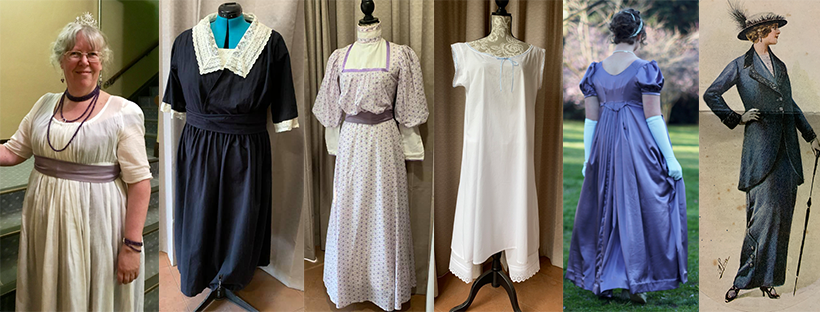
I’m Bronwyn, and I’ve had a long interest in textile and clothing history. Although I’ve always enjoyed dressing up and attending events, over the years my interest has evolved and I’ve become increasingly fascinated by the textiles, construction and sewing techniques involved in historic clothing.
My Honours thesis (2001) was on 18th century British worsted textiles, and it involved researching original clothier’s sample books, and spinning and weaving some small reconstructions of fabric types that were lost and forgotten under the impact of the Industrial Revolution.
From 2018 to 2024 I was involved with the Armidale Folk Museum, in northern NSW, Australia, initially leading a volunteer team to document the clothing and textile collection, and then some contract work leading the small museum team, and curating several exhibitions of dress.
This inspired me to undertake a Master of History degree with a major in public history/applying history. It was a coursework degree with a research project component. For my project I researched the skills of rural dressmakers in colonial, rural Australia in large part through re-creating an 1884 wedding dress in the Armidale Folk Museum collection using the techniques of the extant garment. The dress was well-provenanced to a local bride and would have been made in the district.
In late 2024/2025 I moved 1400km/900 miles south to Ballarat in Victoria, to undertake a PhD at the Australian Catholic University, in collaboration with Sovereign Hill, Australia’s largest and most successful open-air living museum. My project is researching dressmakers on the Ballarat goldfields during the 1850s, and exploring ways to represent the dressmaking trade and dressmakers’ skills in the living museum.
This website documents my research-based practice in constructing historic clothing using, as far as possible, historically-accurate techniques. For clothing from the pre-1850 period, prior to the widespread use of sewing machines, this involves using hand-stitching techniques, some of which are quite different to machine-stitching. It’s been an interesting journey, researching these and putting them into practice, and I still have more to learn.
For the next two years much of my historic sewing will be focused around the 1850s, but there may be the occasional foray into other eras in between PhD sewing. I attend and teach workshops at A Regency Affair in the NSW Southern Highlands each year, so I may squeeze in some updating of my Regency wardrobe. And I do love other eras, so once the PhD sewing is under control (haha!) I may be tempted to the late 18th century, 1880s, Edwardian, 1940s, and even a touch of Steampunk.
